
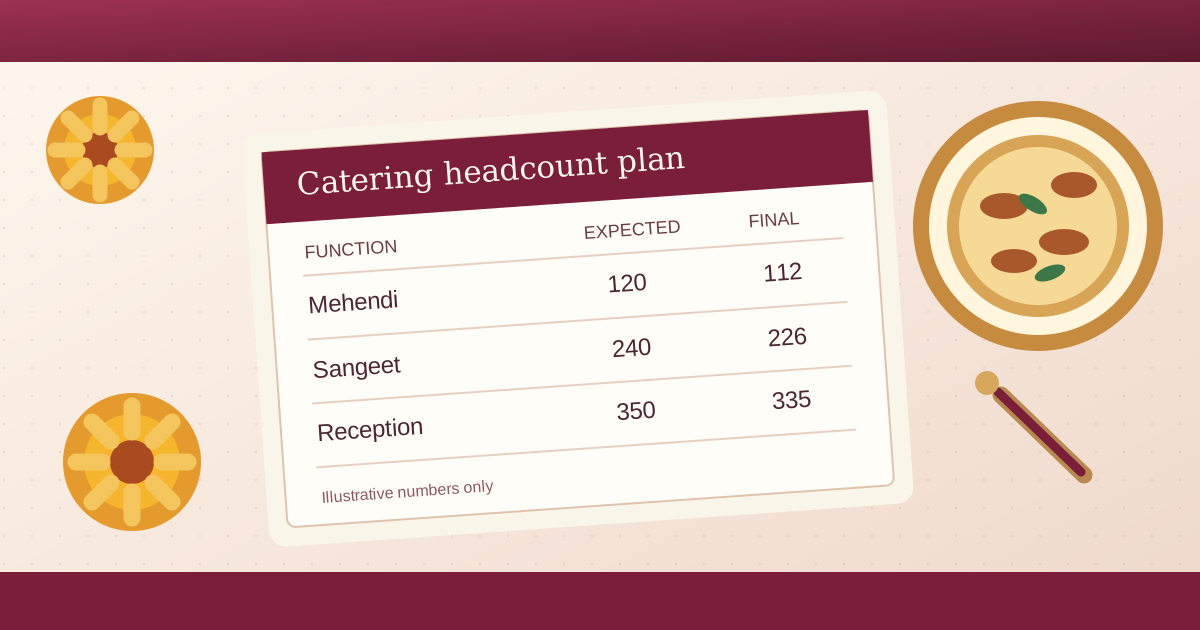
To finalise an Indian wedding catering headcount, calculate attendance separately for every function, remove duplicate entries within each event, confirm meal preferences, agree on a realistic buffer with the caterer, and lock the guaranteed count by the contract deadline. Do not use the total wedding invitation list as your food order.
What is the right catering headcount for an Indian wedding?
Use the number of people likely to eat at a specific function, not everyone invited across the wedding. For each event, start with confirmed attendees, add a carefully assessed share of unanswered invitations, then account for vendors, children, and family members who will actually require meals. The venue's fire-safety capacity is a separate limit.
| Input | What to record | Common mistake |
|---|---|---|
| Confirmed guests | Yes responses for that event | Counting the same person twice |
| Pending replies | Households still to confirm | Assuming every invitee will attend |
| Children | Age bands and caterer meal policy | Assuming all children are free |
| Vendor meals | Photographers, decorators, musicians and crew | Leaving contracted crew out |
| Special meals | Jain, vegan, allergies and other needs | Asking after the menu is locked |
How do you calculate the final meal order?
Try this working formula: estimated meals = confirmed attendees + estimated pending attendees + meal-eligible vendor crew + other approved additions. Discuss any extra buffer separately with your caterer. A buffer is a negotiated operational allowance, not an excuse to count all unconfirmed invitees as confirmed.
Example: a 350-person reception
Suppose 285 people have confirmed, 50 invited guests have not replied, and the family estimates 60% of those pending guests will attend. There are also 12 crew members whose meals are included in the arrangement. The working estimate is 285 + (50 × 0.60) + 12 = 327 meals. If the caterer and family agree on an additional 3% buffer, the planning quantity is about 337 meals, subject to the caterer's rounding and minimum guarantee rules. These are illustrative assumptions, not a universal attendance rate.
At an illustrative ₹1,400 per plate, 337 meals would cost ₹4,71,800 before taxes, service charges or menu extras. Ordering 350 instead would add ₹18,200. The best number depends on your contract and actual RSVP quality, not just the arithmetic.
When should you freeze the guest count?
Check your catering agreement first. Some vendors need a guaranteed minimum several days ahead; others allow a smaller final adjustment closer to service. The timeline below is a planning example, not a standard contract rule.
| When | Action | Owner |
|---|---|---|
| 14 days before | Follow up on missing RSVPs, reconcile households and event access | Guest list lead |
| 7 days before | Share preliminary event-wise headcounts and meal preferences | Family catering lead |
| At contract cut-off | Approve the guaranteed count and written adjustment policy | Decision owner |
| 24 hours before | Confirm service schedule, crew meals and any allowed adjustments | On-site coordinator |
| Event day | Track actual arrivals and flag material changes to the caterer | Welcome desk lead |
How should you handle different counts across Mehendi, Sangeet and reception?
Maintain a separate headcount for each function. A cousin attending Sangeet and reception counts once for each meal service, not once for the entire wedding. Likewise, a hotel guest who attends only breakfast must not automatically be included in reception dinner. Use event-specific RSVP statuses and note who is included in each caterer's scope.
Start with the Indian wedding RSVP tracker, then check the guest list guide to distinguish invited, expected and confirmed guests. If hotel meal packages overlap with the catering contract, reconcile them using the accommodation planning guide.
What should you ask the caterer before confirming numbers?
- What is the guaranteed minimum, and when does it become non-refundable?
- How many extra plates can be prepared, at what rate, and with how much notice?
- Are children, vendor crew and venue staff charged differently?
- Are taxes, live counters, water, service staff and transport included?
- How are Jain, allergy-sensitive and other special meals labelled and served?
- How are actual meals counted, and who signs off on the final bill?
- What happens if one function runs late or guests arrive at the next service?
Put the answers in writing and compare inclusions with the wedding vendor comparison template. Keep payment milestones in the vendor payment schedule guide.
How can you reduce food waste without leaving guests hungry?
Improve the accuracy of event-wise RSVPs, distinguish full meals from snacks, confirm staggered service times, and ask the caterer about replenishment and safe surplus handling. Avoid promising donation of leftovers without checking local food-safety requirements and the recipient's acceptance conditions. Never compromise safe storage temperatures or hygiene to save money.
How does ShaadiScheduler help with catering counts?
Use ShaadiScheduler to keep guest groups, expected attendance, event decisions, budget implications and assigned follow-ups together. Start with one event, enter your expected guest groups, assign someone to chase pending responses, and record the final catering decision. The first useful action is a clean event-wise count, not another spreadsheet copied between family WhatsApp groups.
Start planning free with ShaadiScheduler, then review the guest list and budget before paying your catering advance.
Frequently asked questions
Should I order food for every invited wedding guest?
No. Use event-wise attendance expectations, verified responses and the caterer's guarantee rules. Invitations and meals are different counts.
What is a normal wedding catering buffer?
There is no universally correct percentage. Agree on a buffer based on RSVP uncertainty, contract flexibility, venue logistics and the caterer's ability to replenish.
Do photographers and other vendors need meals?
Often yes, but check each vendor contract and your catering scope. Count only crew who will be on site during the relevant meal service.
Can I change the final guest count on the wedding day?
Only if the contract and kitchen capacity allow it. Confirm the cut-off, additional plate charges and approval contact before the event.