Managing 300 Guests Across 5 Events: An Indian Wedding Guest List Guide
The guest list is where Indian wedding planning gets complicated fast. It's not just a list of names — it's 300 people who each need to be invited to the right subset of five events, seated correctly, tracked for RSVPs, and accounted for in catering.
And it's never just your list. It's your parents' list, your partner's parents' list, and the list that arrives three weeks before the wedding with names you've never heard.
Here's how to manage it without a breakdown.
Why a Single Guest List Doesn't Work for Indian Weddings
Most guest list tools — including basic spreadsheets — are built for one event. You have one guest list, you send one invite, you're done.
Indian weddings don't work that way. You might have:
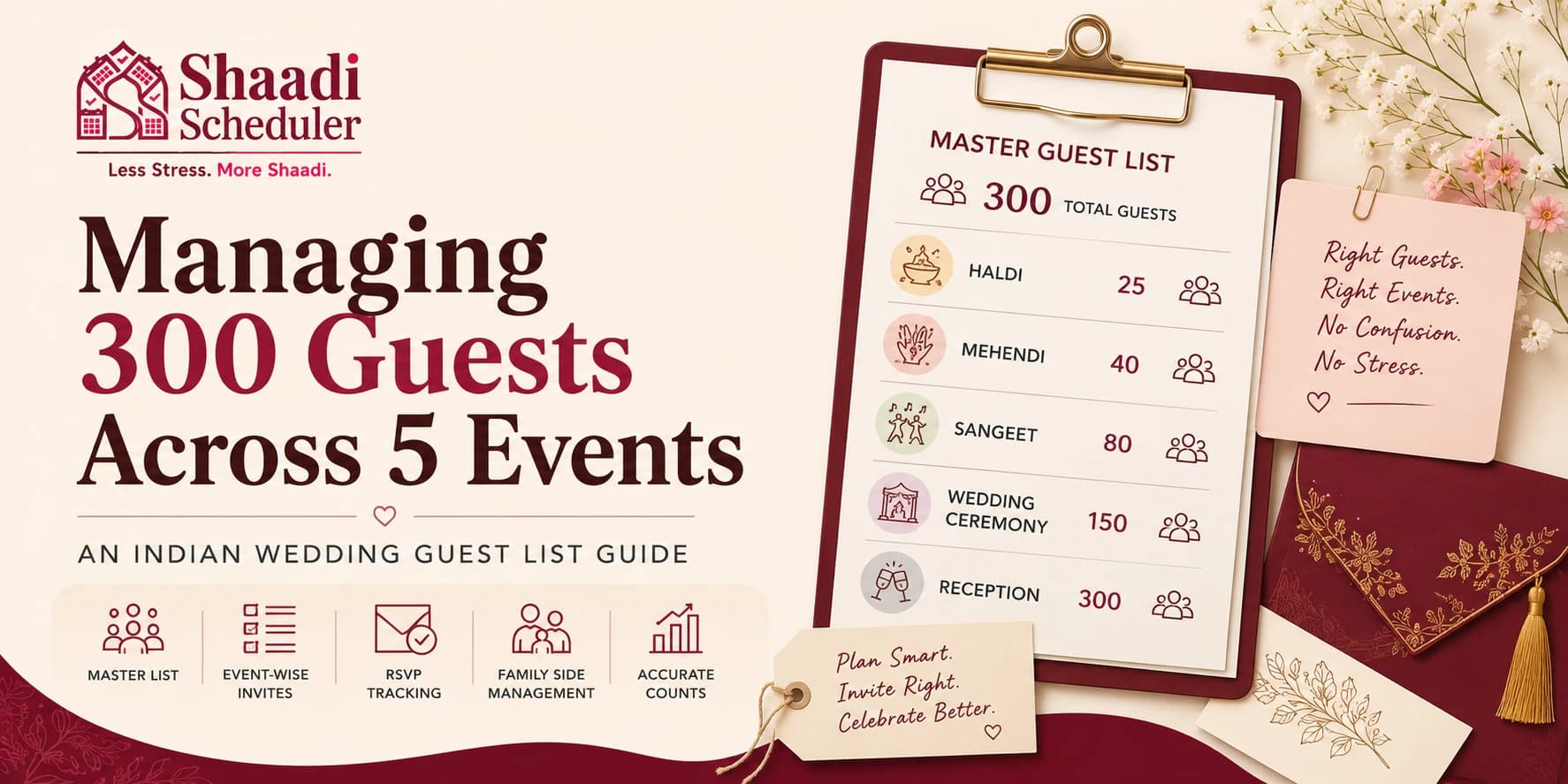
- 300 guests at the Reception
- 150 at the Wedding Ceremony
- 80 at the Sangeet
- 40 at the Mehendi
- 25 at the Haldi
Each event has a different subset of guests. Managing this in a single flat list is how things get missed — someone invited to the Sangeet doesn't get a Ceremony invite, or a family member shows up to the Haldi uninvited because someone assumed they were on the list.
The fix is to treat each event as its own list, connected to a master.
Step 1: Build the Master List First
Before you assign anyone to any event, build one complete master list. Every person who will attend any part of your wedding goes here.
For each person capture:
- Full name
- Family side (bride's side or groom's side)
- Relationship (parent, sibling, cousin, friend, colleague)
- Contact number or email for RSVP
- City (for accommodation planning)
Don't assign events yet. Just get everyone into one place first. This takes one focused session and saves hours of confusion later.
Step 2: Separate Must-Invite from Should-Invite
Before the family discussions begin, sit with your partner and split every name into two columns:
- Must-invite: Non-negotiable. Missing them would cause genuine hurt or damage a relationship.
- Should-invite: Would be nice, but the wedding works without them.
This conversation is easier to have before names become attached to RSVPs, venues, and catering counts. Once invites go out, the list is fixed.
Step 3: Assign Guests to Events
With your master list built, now go event by event and mark who's invited to what.
A practical framework most Indian families use:
- Haldi: Close family only — typically 20–40 people from both sides
- Mehendi: Bride's close family and friends — typically 40–80 people
- Sangeet: Extended family and friends — typically 80–150 people
- Wedding Ceremony: Full list or close to it
- Reception: Full list including work contacts and extended network
These are starting points, not rules. Every family draws the lines differently. What matters is that the lines are drawn clearly and written down — not held in someone's memory.
Step 4: Track RSVPs Per Event, Not Overall
An RSVP of "yes" doesn't mean yes to everything. Someone might confirm for the Reception but not the Sangeet. Your catering count needs to reflect this.
For each event, track:
- Invited count
- Confirmed attending
- Declined
- No response yet
Chase no-responses two weeks before each event — not the day before. Caterers need final counts with enough notice to adjust.
Step 5: Manage by Family Side
Seating, accommodation, and coordination almost always splits by family side. Keep this column populated from the start — it becomes essential in the final two weeks when you're assigning tables and coordinating transport.
It also helps when parents ask "how many people from our side are coming?" — an answer you should be able to give in seconds, not after scrolling through a spreadsheet for ten minutes.
The Spreadsheet Problem
Every couple starts with a spreadsheet. It works fine for the first 50 names. By the time you're at 200, with five event columns, RSVP status, family side, dietary notes, and accommodation flags — it's a maintenance burden that requires a dedicated person to keep accurate.
Many couples tell us the guest list spreadsheet becomes one of the most argued-over documents in the entire planning process. Not because of the people on it — because of who has edit access, which version is current, and whether the catering count reflects the latest changes.
If you're looking for a way to manage this more cleanly, ShaadiScheduler's Guest List handles 300+ guests across 6 events with RSVP tracking and family-side filtering built in. shaadischeduler.com
Handling Late Additions (Because There Will Be Late Additions)
No matter how firmly you close the list, names will arrive late. Here's how to handle them without chaos:
- Set a hard internal deadline two weeks before the first event — after this, new additions require your explicit sign-off, not a parent's
- When a name is added, immediately assign them to events and update the catering count — don't park them as "TBD"
- Keep a 5% buffer in your catering order for late additions and walk-ins
FAQs: Indian Wedding Guest List
How do I limit the guest list when family keeps adding names?
Make the cost per head visible. When parents know that each addition costs real money in catering alone across two or three functions, decisions become more considered. It's not about being difficult — it's about making the trade-off concrete.
Should I use WhatsApp for RSVPs?
WhatsApp works for small lists. For 200+ guests across multiple events, responses get buried in chats and tracking becomes manual. A dedicated RSVP method — even a simple Google Form per event — keeps responses in one place.
How early should I send invites for each event?
Formal invites 4–6 weeks before each event. Follow up with a reminder 1 week before. For out-of-town guests, give 8–10 weeks notice so they can arrange travel and accommodation.
What's the best way to handle dietary requirements across a large guest list?
Capture dietary needs at the RSVP stage, not as a separate follow-up. Add one question to your RSVP process: "Any dietary requirements?" Share the consolidated list with your caterer two weeks before each event.
A guest list is not just a logistics document — it's a map of every relationship your family is choosing to celebrate with. Manage it well and it stays that way. Let it become a spreadsheet nightmare and it becomes the thing you argue about for the last three months of your engagement.