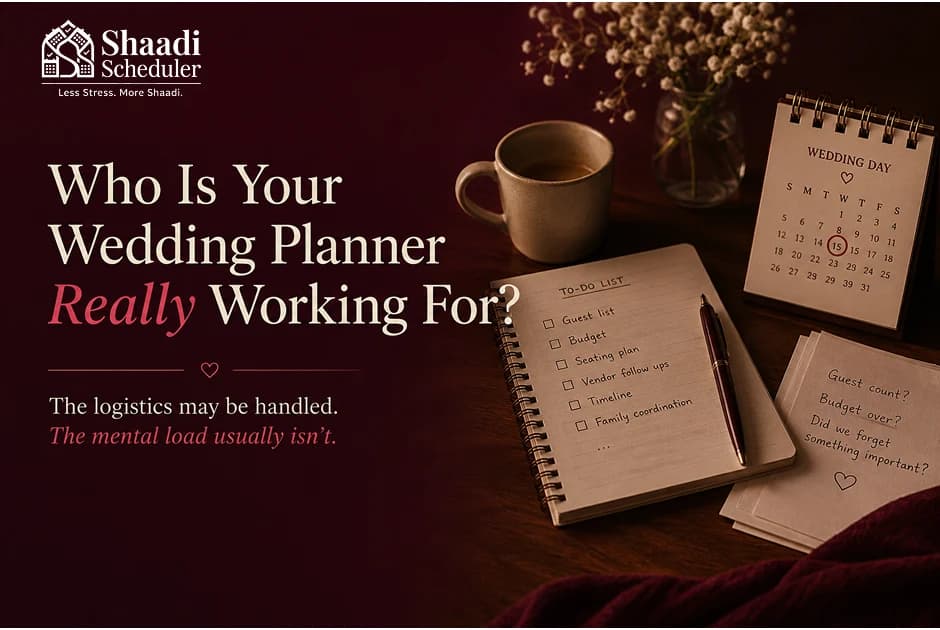
Who Is Your Wedding Planner Really Working For?
The pitch is simple. Hire a planner, hand over the stress, enjoy your wedding. Most couples believe this going in. By month three of planning, the picture looks different.
A wedding planner is genuinely useful. But they're not working for you in the way most couples assume. Understanding what they actually do — and what they don't — changes how you plan, what you delegate, and what you still need to manage yourself.
What a Wedding Planner Actually Does
A good wedding planner manages the operational layer of your wedding. That means:
- Sourcing and coordinating with photographers, decorators, caterers, and other professionals
- Managing timelines across multiple events
- Following up on confirmations and payments
- Troubleshooting on the day when something goes wrong
- Keeping the running order moving when no one else is watching the clock
This is real, valuable work. On the wedding day especially, having someone whose only job is logistics means you're not the one running around finding out why the decorator is late.
What a Wedding Planner Doesn't Do
This is the part the brochure skips.
A planner cannot manage your guest list politics. They can't tell your mother-in-law that 25 last-minute additions won't work with the current seating plan. They can't navigate the family dynamics around who sits where, who gets invited to the Haldi, or why your cousin wasn't included in the wedding party.
They also can't manage your budget anxiety. A planner works within the budget you give them. The decisions about what that budget should be, how to allocate it across events, and how to handle it when it starts drifting — those stay with you. Most couples find that budget stress is one of the things that follows them through the entire planning process regardless of whether they have a planner.
And the 2am spiral? Entirely yours. The sudden panic about whether you've forgotten something, whether the guest count is right, whether the timeline makes sense — a planner is not available for that. That's what the planning anxiety is actually made of, and it doesn't go away because someone else is handling the flowers.
The Redistribution Problem
What hiring a planner actually does is redistribute stress, not eliminate it. The operational stress moves to them. The relational and emotional stress stays with you.
Many couples tell us they were surprised by how much decision-making they still had to do after hiring a planner. A planner can present three venue options. You still have to choose. They can suggest a menu. You still have to sign off. They can propose a timeline. Your family will still have opinions about it.
Every decision still comes back to the couple. The planner just handles the execution once the decision is made.
When a Planner Is Worth It
A wedding planner makes the most sense when:
- You have a large, multi-event wedding with complex logistics across multiple venues or cities
- You and your partner both have demanding careers and genuinely cannot spend time on operational coordination
- You have a clear vision and enough budget to execute it without constant trade-off conversations
- You are comfortable making decisions quickly and don't need to revisit them
A planner is less useful when the real source of your stress is decision fatigue, budget uncertainty, or family dynamics. Those aren't problems a planner solves — they're problems that need a different kind of tool.
When Doing It Yourself Works Better
Couples who plan their own weddings — or who use a planner only for day-of coordination — often report feeling more in control of the outcome. Not because it's easier, but because every decision is theirs. There's no layer of translation between what they want and what gets executed.
The challenge is organisation. Managing guest lists across five events, tracking a budget across twelve categories, keeping a checklist updated across six months of planning — without a system, this becomes unmanageable fast. The couples who do it themselves well aren't more capable than the ones who struggle. They just have a better system.
If you're managing the parts a planner doesn't touch — the guest list, the budget, the planning anxiety — ShaadiScheduler is built specifically for those problems. shaadischeduler.com
The Honest Answer
Most Indian couples end up with a hybrid. A planner or coordinator for day-of logistics. Their own system for everything else. That's not a compromise — it's actually the most effective setup for most weddings.
The mistake is assuming a planner handles everything, handing over the mental load completely, and then being surprised when the anxiety doesn't follow.
FAQs: Wedding Planners in India
How much does a wedding planner cost in India?
It varies widely. Full-service planners typically charge a percentage of the total wedding budget, often 10-15%, or a flat fee. Day-of coordinators are significantly cheaper and handle only the execution, not the planning. For most couples, a day-of coordinator with their own planning system is the most cost-effective setup.
What's the difference between a wedding planner and a day-of coordinator?
A planner is involved throughout — sourcing, planning, coordinating across the engagement period. A day-of coordinator steps in for the final week and the events themselves, managing the running order and logistics on the ground. If you've done your own planning and just need someone to execute, a coordinator is usually enough.
Can I plan an Indian wedding without a planner?
Yes. Many couples do. The key is having a clear system for guest management, budget tracking, and event-by-event checklists. The operational complexity of an Indian wedding is manageable — it just needs to be organised.
What does a wedding planner not help with?
Family dynamics, guest list politics, budget decisions, and the mental load of planning. These stay with the couple regardless of whether a planner is involved. A planner handles the operational layer. The emotional and relational layer remains yours.
Knowing what you're hiring a planner for — and what you're not — is the most useful thing you can do before signing a contract.