
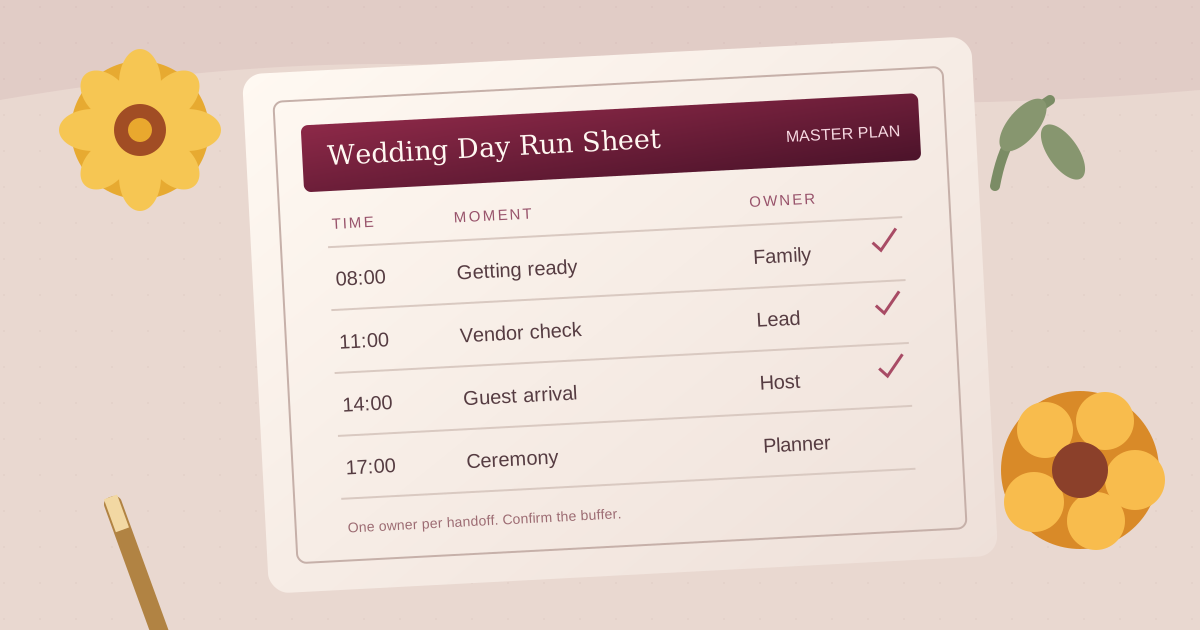
An Indian wedding day run sheet is a shared minute-by-minute plan that tells each family member and vendor what happens, when it happens, who owns it, and what to do if something runs late. Start with the ceremony time and venue rules, work backwards through preparation and arrivals, then add realistic travel and setup buffers. Give one person authority to coordinate changes so the couple can enjoy the day.
Unlike a month-by-month wedding checklist, a run sheet is for the final execution window. It covers the ceremony, reception and any same-day Haldi, Mehendi or Sangeet functions. The sample below is a starting point, not a prescribed religious or regional sequence. Confirm rituals and auspicious timings with your family and officiant.
What should a wedding day run sheet include?
For every activity record the planned start, planned finish, venue or room, responsible person, contact, dependencies and backup plan. Keep the latest version accessible to the coordinator and relevant vendors, but share guest-facing timings separately.
| Field | Why it matters | Example |
|---|---|---|
| Start and finish | Shows the real duration | 11:00 to 11:30 |
| Activity | Defines the outcome | Sound and microphone test |
| Owner | One person accountable | Production lead |
| Dependency | Prevents handoff confusion | Stage power available |
| Backup | Explains what happens if late | Use spare microphone |
Sample Indian wedding day timeline
This illustrative schedule assumes a late-afternoon ceremony followed by a reception at the same venue. Replace every time with your confirmed ceremony schedule, venue access, travel distances and local rules.
| Time | Activity | Responsible owner |
|---|---|---|
| 07:30 | Venue access, power, safety and weather check | Venue coordinator |
| 08:30 | Decor and production setup | Decor lead |
| 09:00 | Hair, makeup and dressing begin | Styling lead |
| 11:00 | Sound, lighting and catering readiness check | Production and catering leads |
| 12:00 | Family lunch, water and rest buffer | Family host |
| 13:00 | Photography and immediate-family portraits | Photo lead |
| 14:30 | Transport and guest arrival desk open | Transport and welcome leads |
| 15:30 | Final ritual materials and seating check | Ceremony coordinator |
| 16:00 | Guest seating and ceremony briefing | Usher lead |
| 17:00 | Ceremony begins at confirmed family timing | Officiant and ceremony coordinator |
| 19:00 | Photos, refreshments and reception transition | Photo and hospitality leads |
| 20:00 | Reception and dinner service | Emcee and catering leads |
| 22:00 | Guest departures, transport and vendor closeout | Transport and venue leads |
Do not copy this timeline unchanged. A morning muhurtham, baraat procession, church service, nikah or multiple venue transfers requires a different sequence. Build around non-negotiable timings first.
How much buffer should you add?
Use buffers where delays are expensive: between makeup and departure, transport and ceremony, guest seating and rituals, and ceremony and reception changeover. For a local transfer estimated at 35 minutes, scheduling only 35 minutes is fragile. Consider traffic, parking, vehicle boarding and accessibility, then agree a realistic departure time with the transport lead. Do not use a single fixed buffer percentage for every wedding.
Label each activity as fixed (ritual timing, venue closing), flexible (portraits, speeches) or optional (extra group photos). If you are 25 minutes late, trim optional items first rather than pushing a fixed ceremony or missing vendor access.
Who should own wedding day coordination?
Assign one overall day lead and separate owners for venue, ceremony, vendors, guest hospitality, transport and payments. The lead should have a current contact sheet and authority to make minor timing changes within agreed limits. The couple should not be the default escalation point for missing chairs or late deliveries.
- Overall lead: owns the master run sheet, change log and escalation decisions.
- Vendor lead: confirms arrivals, deliverables, setup and pack-down.
- Family host: manages elders, guest questions and sensitive family needs.
- Transport lead: tracks pickups, drivers and departure queues.
- Finance owner: holds agreed payment schedule and authorised approvals.
How do you coordinate vendors without 20 phone calls?
Send each vendor a filtered schedule showing only their arrival window, setup deadline, performance time, loading access and contact person. Ask for written acknowledgement 48 hours before the event. At the start of the day, run a brief readiness check: power, access, crew, deliverables, meals and contingency equipment.
Use the vendor comparison guide to review service scope before booking and the vendor payment schedule to avoid surprise balances on the wedding day. A run sheet is not a substitute for signed vendor terms.
What changes when functions happen at multiple venues?
Make a separate schedule for each venue and one shared transfer timeline. Include loading times, parking, accessible pickup locations, contingency vehicles and a named person who confirms the final guest group has departed. If a ceremony finishes at 18:00 and reception starts at 19:00 across town, do not assume the transfer will fit without testing actual traffic and boarding time.
For outstation families, connect the run sheet with the room allocation and check-in tracker. For function-wise attendance and meal counts, use the RSVP tracker guide. Share the minimum necessary guest information with each service team.
What should you confirm 7 days, 48 hours and 2 hours before?
Seven days before
Lock venue access, key ritual timings, vendor scope, transport plan, weather alternatives and the owners of every critical handoff. Check the final 30-day checklist for outstanding preparations.
Forty-eight hours before
Confirm vendor attendance, contact numbers, headcounts, arrival points, room allocation and all setup windows. Circulate a version number and date so nobody works from an outdated screenshot.
Two hours before
Check the ceremony area, sound, seating, transport readiness, water, accessibility and any required ritual materials. Escalate blocked items to the day lead and record the new owner or workaround.
How can ShaadiScheduler help?
Use ShaadiScheduler to keep your wedding events, checklists, guest planning and decisions organised before the big day. Create an event-wise task list with named family owners, review pending decisions, and use the budget tracker guide for remaining commitments. Maintain the minute-by-minute operational run sheet with your chosen coordinator and vendors. ShaadiScheduler does not automatically dispatch vendors or track drivers live.
Want fewer last-minute surprises? Start planning your Indian wedding free with ShaadiScheduler, add your functions and assign the next three tasks to real owners today.
Frequently asked questions
Is a wedding day run sheet the same as a wedding planning checklist?
No. A planning checklist tracks work across weeks or months. A run sheet coordinates people, locations and exact handoffs during the event itself.
Who should receive the master schedule?
The overall coordinator and core leads need the master version. Give vendors and guests shorter schedules relevant to them, rather than exposing every family contact or private note.
What if the ceremony starts late?
Protect fixed ritual and venue commitments, notify the reception and transport leads, and shorten flexible items such as portraits or speeches where appropriate.
When should we finalise the timeline?
Draft it once key vendors and ceremony times are confirmed, review it one week before the wedding, and reconfirm operational details 48 hours before.