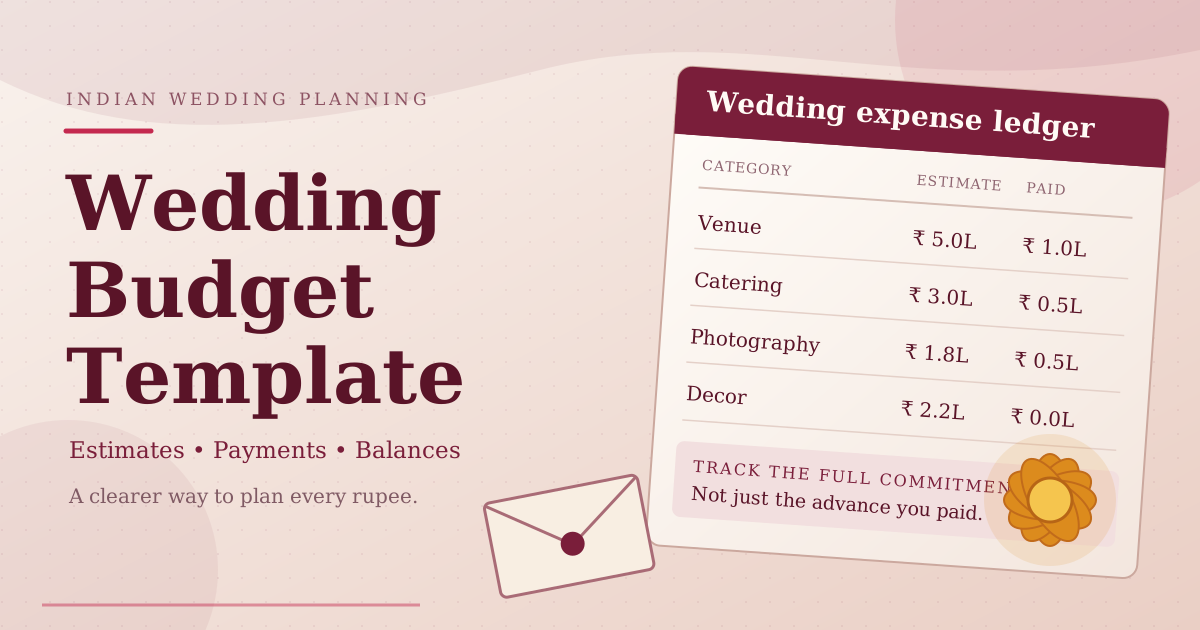
A useful Indian wedding budget template should show what you planned to spend, what vendors have quoted, what you have committed to pay, what you have already paid and what is still due. Keep those five numbers separate. Otherwise, a ₹50,000 advance can make a ₹2,00,000 photography booking look like a ₹50,000 expense.
Use this free editable tracker for a multi-function Indian wedding. It works in Google Sheets or Excel, and it includes columns for vendor payments, due dates, owners and separate events. The sample figures below are illustrations, not typical market prices.
Download the free Indian wedding budget tracker (CSV). Open the file in Google Sheets or Excel, save a personal copy, and replace the example with your own quotes.
What columns should a wedding budget template have?
One row should represent one cost or vendor commitment, not an entire wedding function. A photographer covering three functions may be one contract, while catering for three functions may need three rows with different guest counts.
| Column | What to enter | Why it matters |
|---|---|---|
| Category and function | Venue, catering, decor, Mehendi, ceremony, reception | Shows which event drives the expense |
| Estimated INR | Your first planning allowance | Preserves the original baseline |
| Quoted INR | Latest full vendor quote | Makes price changes visible |
| Committed INR | Agreed total after booking | Captures the real obligation |
| Paid INR | Total advances and instalments paid | Tracks cash already spent |
| Balance INR | Committed minus paid | Shows money still owed |
| Next payment date | Contractual due date | Prevents cash-flow surprises |
| Owner, status, notes | Responsible person, booking stage, exclusions | Prevents lost decisions |
How do you use the free wedding budget spreadsheet?
- Set a confirmed ceiling. Include only funds that are actually available or firmly committed by family members. Decide whether jewellery, gifts and honeymoon belong inside it.
- Reserve contingency first. A 10% buffer is a planning starting point, not a universal benchmark. For a ₹20 lakh ceiling, set aside ₹2 lakh and plan the remaining ₹18 lakh.
- Import the CSV. In Google Sheets, create a sheet and use File, Import, Upload. In Excel, open the CSV and save it as an Excel workbook if you want multiple tabs.
- Add one row per commitment. Keep the full vendor amount in Committed INR even after paying an advance. The sample balance formula subtracts Paid INR from Committed INR.
- Update after every decision. Enter revised quotes, confirmed costs and payment dates. Add a new row when a new function or expense is approved.
- Review weekly. Compare the forecast against the ceiling, then check which payments fall due before the next family contribution arrives.
The template has a worked photography example and blank rows for common wedding categories. It is a starting structure, not a substitute for your actual vendor contracts.
How do you calculate your wedding budget without double counting?
Use four different totals, each answering a different question:
- Planned budget: the amount you are willing and able to spend, including contingency.
- Forecast cost: confirmed commitments plus current estimates for items not yet booked. Do not add the estimate again for a vendor already committed.
- Paid to date: cash already paid to vendors.
- Outstanding committed balance: all confirmed vendor totals minus payments made against those commitments.
For example, suppose a couple has a ₹20 lakh ceiling and keeps ₹2 lakh as contingency. Their working allocation is ₹18 lakh. If confirmed commitments total ₹12.4 lakh, unbooked items are forecast at ₹4.6 lakh, and they have paid ₹5.1 lakh:
| Measure | Illustrative amount | Interpretation |
|---|---|---|
| Confirmed ceiling | ₹20,00,000 | Total funds allocated to wedding |
| Contingency reserve | ₹2,00,000 | Held for changes and surprises |
| Working allocation | ₹18,00,000 | Planned spending before reserve |
| Confirmed commitments | ₹12,40,000 | Full value of booked items |
| Unbooked forecast | ₹4,60,000 | Estimated remaining items |
| Current forecast | ₹17,00,000 | ₹1 lakh below working allocation |
| Paid to date | ₹5,10,000 | Already paid, part of commitments |
| Committed balance due | ₹7,30,000 | ₹12.4 lakh minus ₹5.1 lakh |
The ₹5.1 lakh already paid is not an additional expense on top of the ₹12.4 lakh committed. This is the most important rule in a wedding expense tracker.
What does a ₹20 lakh Indian wedding budget allocation look like?
Here is one illustrative allocation for a wedding with several functions. These are not vendor price estimates or averages. Your city, dates, guest count, food choices, jewellery and family arrangements can produce a very different distribution.
| Category | Illustrative allocation | Check before approving |
|---|---|---|
| Venue and catering | ₹7,20,000 | Guest guarantees, taxes, service and overtime |
| Decor and production | ₹2,50,000 | Stage, mandap, flowers, power and setup |
| Photography and video | ₹1,60,000 | Functions, hours, deliverables, travel |
| Outfits and styling | ₹1,60,000 | Alterations, accessories, trials |
| Rooms and transport | ₹1,40,000 | Room nights, transfers and driver hours |
| Entertainment | ₹1,00,000 | Sound, artist, rehearsal and licensing if relevant |
| Invitations, gifts and rituals | ₹1,20,000 | Printing, materials, hospitality |
| Coordination and miscellaneous | ₹1,50,000 | Staff, deliveries and unlisted planned costs |
| Contingency held separately | ₹2,00,000 | Release only for an approved need |
| Total | ₹20,00,000 | Includes contingency |
Use the budget checklist before booking vendors to decide what belongs inside your ceiling. For a detailed view of why costs drift, see why Indian wedding budgets spiral.
How should you track costs across Mehendi, Sangeet, ceremony and reception?
Keep one master budget but tag every row by function. For a shared photography package, use one row labelled "Multiple functions" so you do not count it four times. For catering, use separate rows for each event because the guest list and menu can differ.
Suppose the reception has 250 expected guests and the illustrative food price is ₹1,200 per person. Food alone would be ₹3,00,000 before any other charges. At 200 guests it would be ₹2,40,000; at 300 guests it would be ₹3,60,000. That is a ₹1,20,000 spread across those scenarios, even before decor, seating, rooms or venue minimum guarantees change.
Record invited, expected and confirmed guests separately. Read our WhatsApp RSVP tracker guide for function-wise confirmations, and the guest-list management guide for coordinating larger weddings.
How do you prevent vendor payments from causing a cash-flow problem?
A wedding may fit the overall ceiling but still be difficult to pay for if several balances fall due in the same week. Enter the advance, milestone and final payment dates from the written agreement. Use additional rows or a separate payment schedule when one vendor has several due dates, but keep the committed contract total counted only once in the budget forecast.
Before paying, verify whether the quote includes taxes, travel, extra hours, cancellation terms, changes to guest guarantees and refundable deposits. A refundable security deposit may not be a final expense, but it still needs cash available on the day it is due.
Our vendor payment schedule guide explains deposits, milestones and final balances in detail.
When is a spreadsheet no longer enough?
A spreadsheet is useful when one or two people keep it updated. It becomes fragile when family members maintain different copies, RSVP changes are stuck in chats, or decisions are approved without updating costs. If the same guest change has to be entered into five places, the system is costing you time.
ShaadiScheduler connects wedding budgeting with guests, checklists, decisions and Scenario Lab. Use Budget Tracker to manage estimated and actual costs, and Scenario Lab to explore trade-offs such as fewer guests or a different event plan before committing. The app does not automatically import this CSV or collect vendor payments, so keep receipts and contractual dates in your own records.
Start a free ShaadiScheduler wedding plan to move from a disconnected budget file to a more coordinated planning workflow. For a side-by-side comparison, read when to switch from a spreadsheet to a wedding planning app.
Frequently asked questions
What should an Indian wedding budget template include?
Track the function, category, vendor, estimated amount, quoted amount, committed total, amount paid, balance due, next payment date, owner and status. Keep contingency separate from committed costs.
Can I use this wedding budget template in Google Sheets?
Yes. Download the CSV, import it into Google Sheets or Excel, and save your own copy. The example rows and balance formulas are editable.
How do I calculate outstanding wedding vendor payments?
For each confirmed booking, subtract payments already made from the total committed amount. Do not subtract advances from the overall wedding cost, since the commitment remains the full contract value.
How much contingency should I keep in an Indian wedding budget?
A 10% reserve is a useful starting planning assumption, not a fixed industry rule. Increase it if guest counts, travel, weather arrangements or vendor scopes are still uncertain.
Does ShaadiScheduler automatically import this CSV or collect vendor payments?
No automatic CSV import or vendor payment collection is promised here. ShaadiScheduler helps couples organise budget estimates, actuals, guests and decisions, and explore trade-offs through Scenario Lab.
Make the next payment a decision, not a surprise
Start with a clear ceiling, track the full value of every booking, and review upcoming balances every week. Download the wedding budget template, add your real numbers, and use ShaadiScheduler when you want budgets, guests and decisions to stay connected.