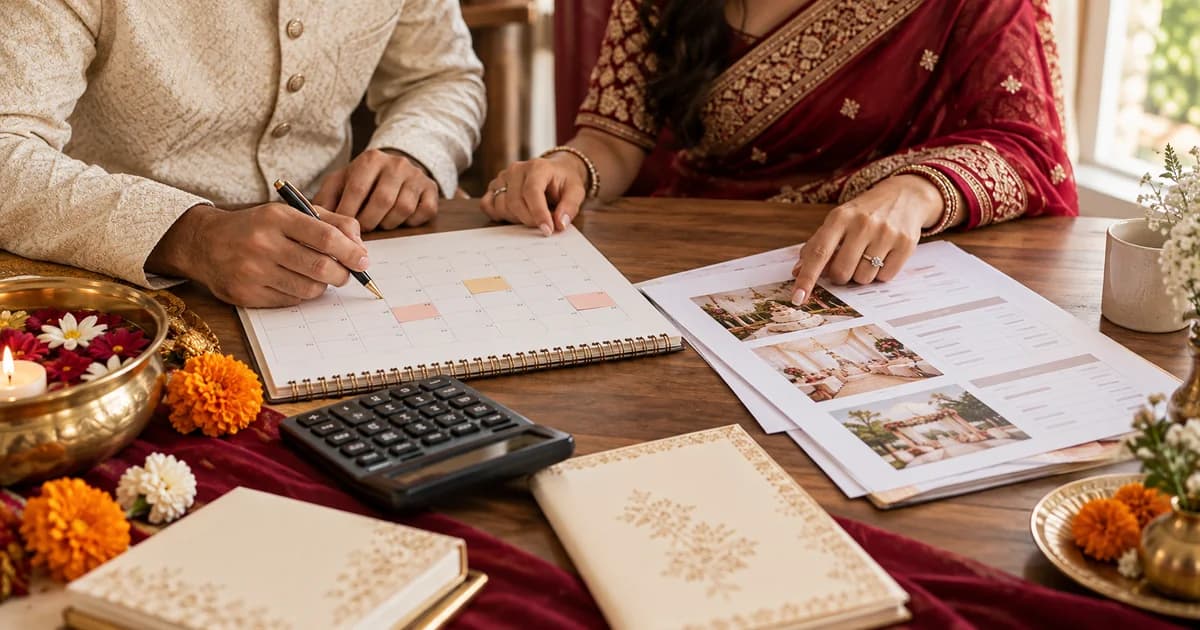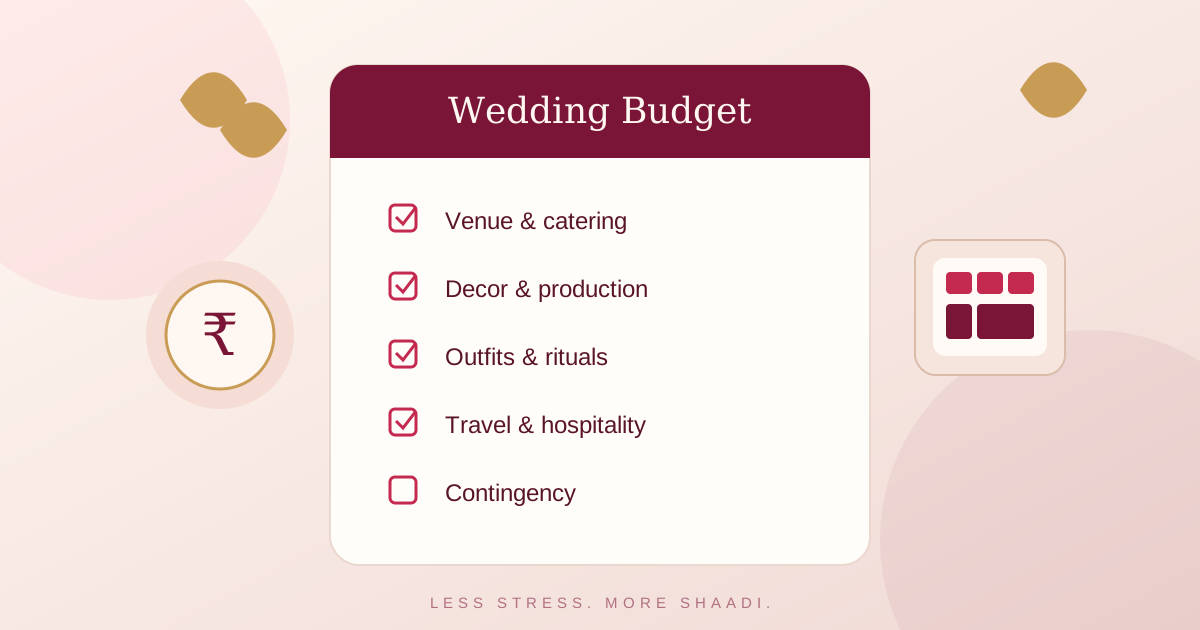

Choosing a wedding venue feels like one decision. In an Indian wedding, it is usually twenty decisions hiding inside one booking.
The venue affects your guest capacity, catering, decor, photography, parking, rooms, ceremony setup, family logistics and sometimes even the running order of the entire wedding week.
That is why a venue can look perfect during a one-hour walkthrough and become a headache six months later.
Before you pay the advance, use this checklist. The goal isn't to find the prettiest venue. It is to understand exactly what you are buying, what is included, and what will become your problem later.
Quick answer
Before booking an Indian wedding venue, confirm 17 things: capacity for each function, what is included, vendor restrictions, catering rules, guest-count changes, parking, setup access, sound limits, rain backup, rooms, decor restrictions, cancellation terms, overtime charges, the venue-day contact, the full guest journey, and the total expected cost.
The most important rule is simple: compare the total cost and operational fit, not just the venue's headline price.
1. What is the actual capacity?
Don't stop at the number the venue gives you.
Ask for capacity in the exact setup you plan to use: seated dining, theatre-style ceremony, buffet, stage, dance floor, DJ, photo area and family seating.
A hall that technically holds 500 people may feel completely different when 500 people are seated for dinner and you have a large stage at one end.
2. Is the capacity the same for every function?
Indian weddings rarely have one guest list.
Your Mehendi, Haldi, Sangeet, ceremony and reception may all have different numbers. Ask whether the venue can comfortably support each event and whether different halls or spaces can be used across the wedding.
This is also where your guest list needs to meet your venue plan. A final guest count is not just a number. It changes catering, seating, parking and the amount of space your decor needs.
3. What exactly is included in the venue price?
Get the inclusions in writing.
- Tables and chairs
- Basic lighting
- Power backup
- Air conditioning
- Cleaning
- Security
- Parking
- Rooms or changing rooms
- Basic stage or mandap structure
- Sound equipment
- Kitchen access
A low venue quote can become expensive when essential items are treated as add-ons.
4. Can you bring your own vendors?
Some venues have preferred or mandatory vendors. Others let you bring anyone.
Ask specifically about:
- Caterer
- Decorator
- Photographer
- DJ or sound team
- Makeup artist
- Mehendi artist
- Entertainment
If outside vendors are allowed, ask whether there is a vendor entry fee, service charge or additional security deposit.
5. Is outside catering allowed?
This can change your entire wedding budget.
Ask whether the venue requires its own caterer, allows outside catering, charges a kitchen or corkage fee, and provides a usable preparation area.
Also ask whether the quoted catering price includes service staff, crockery, water, tea and coffee, live counters, cleaning and late-night service.
6. What happens if the guest count changes?
This is one of the most important questions for an Indian wedding.
If you add 50 guests three months later, what changes?
- Per-plate catering cost?
- Minimum guarantee?
- Seating capacity?
- Parking?
- Room allocation?
- Hall or venue fee?
Don't build your budget around today's guest estimate without understanding how the venue reacts when that number moves.
7. How much parking is actually available?
Don't accept "ample parking" as an answer.
Ask for the approximate number of cars the venue can accommodate, whether parking is exclusive to your wedding, whether valet is available, and where overflow vehicles will go.
For large weddings, parking is part of the guest experience. It is also one of those problems that becomes very difficult to solve on the day itself.
8. What are the access and setup timings?
Ask when your decorator can enter. Ask when the caterer can arrive. Ask when the photographer can begin setup. Ask when your family can access the rooms.
A venue that gives you only a short setup window can make an otherwise simple decor plan extremely stressful.
If you are hosting multiple functions on the same day, ask exactly when each team gets access to the space.
9. Are there sound or timing restrictions?
Ask about music cut-off times, DJ restrictions, outdoor sound limits, generator noise and any local rules the venue follows.
Don't discover the venue's sound policy when your Sangeet is already underway.
10. What is the rain plan?
If any part of the wedding is outdoors, this question is mandatory.
Ask what happens if it rains and whether the backup space can accommodate the same guest count, stage, catering and seating.
Also ask when the venue makes the call to move indoors. A backup plan that exists only on paper isn't much of a backup.
11. Are there rooms for the people who actually need them?
Don't only count rooms. Map them.
Which room is for the bride? Where does the groom get ready? Where can elderly family members rest? Is there a private space for makeup? Can vendors access the area without walking through guest spaces?
Small logistical details become big problems when the venue is full.
12. What are the rules around decor?
Ask what your decorator can and cannot do.
- Can anything be hung from the ceiling?
- Are candles allowed?
- Can the decorator use nails, tape or hooks?
- Are there restrictions on floral installations?
- Can the mandap be built to your preferred size?
- Can furniture be moved?
- Who is responsible for damage?
Get the rules before you approve a decor concept.
13. What is the cancellation and postponement policy?
Read the contract before transferring the advance.
Ask what happens if you postpone, reduce the booking, change the date, cancel the wedding or need to move the event because of circumstances outside your control.
Also check the payment schedule, taxes, refundable amounts and deadlines for final guest numbers.
14. What is the overtime policy?
Weddings rarely end exactly when the spreadsheet says they will.
Ask what happens if the ceremony runs late, guests stay longer, the decorator needs extra time, or the cleanup goes beyond the contracted window.
Know the hourly or fixed overtime charges before you need them.
15. Who is your point of contact on the wedding day?
You should have one named person from the venue who is responsible for operations.
Ask for their name and role. Find out who handles power, housekeeping, security, parking, catering coordination and emergency issues.
And ideally, the couple should not be that person.
16. Walk through the entire guest journey
This is the test most couples skip.
Don't just stand in the hall and look at the decor potential. Walk the route.
Where does a guest park? Where do they enter? Where do they find the ceremony? Where do they leave their footwear? Where are the washrooms? Where is the dining area? Where does an elderly guest sit? Where does a child wait? Where does the bride enter?
If the journey feels confusing when the venue is empty, it will be much worse when hundreds of people arrive.
17. Get the final commercial picture
Before you compare venues, put every cost into one sheet.
At minimum, track:
- Venue rental
- Catering minimums
- Taxes
- Outside-vendor fees
- Parking or valet
- Power or generator charges
- Room charges
- Overtime
- Security deposits
- Cleaning charges
- Cancellation terms
Then compare venues using the total expected cost, not the headline venue price.
The venue decision is connected to everything else
This is why venue selection should not happen in isolation.
Change the venue and you may change the catering cost. Change the guest count and you may change the venue requirement. Change the event format and you may need a different hall. Add a Sangeet and suddenly sound, stage and timing restrictions matter.
Indian wedding planning is a system of connected decisions. The expensive mistakes are usually not individual decisions - they are decisions made without seeing what they affect.
That's the problem ShaadiScheduler is built around. Your wedding isn't a list of independent tasks. It is a set of decisions that keep changing one another.
Turn the venue decision into a real wedding plan
Once you have shortlisted a venue, the next challenge is keeping the guest count, budget, tasks and decisions connected. ShaadiScheduler gives you one shared place to build the plan, assign responsibilities and keep the important decisions visible to the people helping you.
Turn the venue checklist into an actual wedding plan
Once you have answers to these 17 questions, the next challenge is keeping those decisions connected. In ShaadiScheduler, your venue, guest count, budget and wedding tasks can live in one shared planning system instead of separate spreadsheets and WhatsApp conversations.
You can build your checklist, track the budget, manage guests and use the Scenario Lab to understand how one decision affects another. Start planning your Indian wedding with ShaadiScheduler for free.
If you're still building the rest of your planning system, start with our guide to wedding planning tools in India, and make sure your guest planning doesn't become a separate spreadsheet living on someone's laptop.
Venue viewing checklist
| Question | Confirmed? |
|---|---|
| Capacity for each function | ☐ |
| Exact inclusions | ☐ |
| Outside vendors allowed | ☐ |
| Outside catering allowed | ☐ |
| Parking capacity | ☐ |
| Setup and access timings | ☐ |
| Sound restrictions | ☐ |
| Rain/backup plan | ☐ |
| Rooms and changing areas | ☐ |
| Decor restrictions | ☐ |
| Cancellation/postponement terms | ☐ |
| Overtime charges | ☐ |
| Day-of venue contact | ☐ |
| Total expected cost | ☐ |
Questions couples ask before booking a wedding venue
How far in advance should you book an Indian wedding venue?
For popular dates and high-demand venues, couples often need to shortlist and compare venues well before the wedding. The exact timing depends on the city, wedding season, guest count and venue availability, so confirm availability before building the rest of the plan around a date.
What should I check before paying a wedding venue advance?
Confirm the contract, payment schedule, cancellation and postponement terms, total expected cost, inclusions, vendor restrictions, catering rules, capacity, parking and setup timings before paying the advance.
How do I compare two wedding venues?
Put both venues into the same comparison sheet. Compare the total expected cost, capacity, catering, vendor flexibility, access timings, parking, rooms, restrictions and operational fit for each function.
What is the biggest wedding venue mistake to avoid?
Do not make the decision from appearance alone. A venue can look perfect and still create problems through capacity limits, restrictive vendor policies, short setup windows, parking constraints or unexpected charges.
The rule before you book
Don't ask whether you love the venue.
Ask whether you understand the venue.
You can fix a colour palette. You can change a menu. You can add flowers.
You cannot easily fix a venue that is too small, too restrictive, too difficult to access, or full of costs you didn't know existed.
Book the place you understand - not just the place that looks beautiful for an hour.
And once the venue is locked, put the decision into your wider wedding plan. That's where the real work begins.